


The Fading of All Lesser Lights
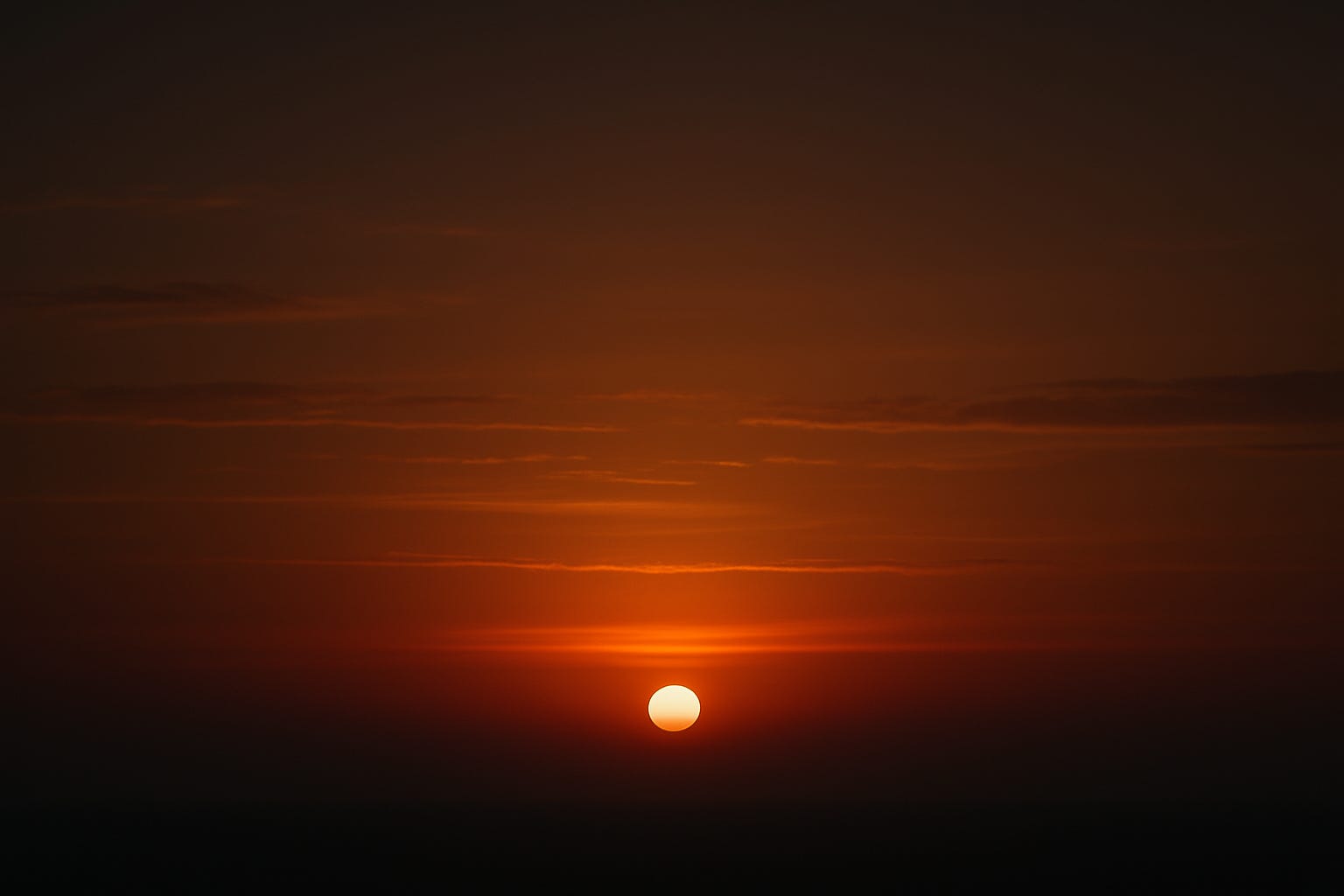
The first sound of creation were four words “Let there be light” (Gen. 1:3). Before the sun or moon, light itself was called out of nothing, blazing at God’s command. Only later did He make lamps to hang it, the sun to rule the day and the moon to rule the night (Gen. 1:16). Since the dawn of time, every sunrise was a countdown to sunset. We never think of it as setting forever. But it will.
For six thousand years our sun has run its race, tirelessly (Ps. 19). Scientists tell us it will one day burn out, give or take a billion years. Scripture already said it would: “the fashion of this world passeth away” (1 Corinthians 7:31). One day, that earthly light will go out. There will be no more sun (Isaiah 60:19, 20). The rays that ripened our fields, the light that burst through our kitchen windows, the moon that lit our sleepless nights, they will be gone forever.
When John describes what lies beyond this world he surprisingly says, “The city had no need of the sun … for the glory of God did lighten it, and the Lamb is the light thereof.” The sun has always been a constant for us. But this passage now turns it into a 6000-year-old placeholder of the Glory of God, and light of the Lamb.
Humanly, we find it hard to make true sense of this verse. It sounds beautiful, but how to imagine it? How can the Glory of God and the Lamb light that city? Yet if we see with new eyes, part of it is not so hard to understand. But only in part (1 Cor. 13:9).
Tell me, what is light? Can you define it? Can you capture it? (lightning bugs excluded). Most of us have no idea what light actually is. We know it is photons with no mass, it has motion, and energy moving at a speed incomprehensible. It touches what it passes, yet remains untouched itself. It fills every space it enters, but has no mass or substance. That’s all we really know. Every created light, from the smallest spark to the gretest supernova, is simply borrowed from that first command. For the most part, light is a complete mystery to us. We simply take this miracle for granted. We should not. It is a gift the blind have never had.
The City
Before we get further into the light, let’s look at the city herself. Remember, John is trying to capture what he is seeing in the spirit (Rev. 1:10; 4:2), with his first century vocabulary, thousands of year in the future. We do not envy his task. When it came to describing what John was seeing, it was easier for him to use metaphor than describe the indescribable. How often he seems to pile up words, using “like”, and “as”, and “like unto.”
“His head and his hairs were white like wool, as white as snow; and his eyes were as a flame of fire” (Rev. 1:14). None of that was what he actually saw. It was like it. “And his voice as the sound of many waters”, not actually many waters (1:15). “His countenance was as the sun shineth in his strength” (1:16), not the actual sun.
Imagine being a 1st Century writer transported to Times Square, at night. Then trying to write about it in the vocabulary of ancient Koine Greek. Thankfully, symbols, and likenesses, and comparisons, in descriptive language, remain timeless.
So what is this city?
The City is the New Jerusalem, the Bride herself adorned and made ready. John says, “Come hither, I will shew thee the bride, the Lamb’s wife… and he showed me that great city, the holy Jerusalem” (Rev. 21:9–10). Heaven, in its final and fullest sense, is the King of that City and His perfected bride joined in everlasting union (Heb. 12:22,23).
The city’s measurements are equal in length, breadth, and height (Rev. 21:16). A perfect cube, matching the description of the Most Holy Place over which the Shekinah rested (1 Kings 6:20). That’s very interesting. In means the Holy of Holies is now the new creation. No corner is left outside the presence of God (Rev. 21:1).
Her foundations are precious stones, each gleaming with element light (Rev 21). Her walls are salvation itself, transparent yet impenetrable (Isa. 26:1). All gates are as pearls, open, never shut, because nothing unclean can enter (Rev. 21:21, 25, 27). Through the middle of this city runs the river of the water of life, clear as crystal, proceeding from the throne of God and of the Lamb (Rev 22). On either side grows the tree of life, whose leaves are for the healing of the nations (Rev. 22:2).
If you wanted to put it simply (and it can’t be simply put): the City is all creation finally become worship (Ps. 150:6; Rom. 8:21), and a glorified bride finally coming home (Rev. 19:7). It is the last garden and the First Church of Eternity, one and the same.
How Can This Be?
“Sun and moon,” “Glory of God” and “the Lamb.” These are four lights. Two created, two Uncreated. Interesting contrast. We could say, the prophetic lights and fulfillment Lights. Scripture says: “God is light, and in him is no darkness at all” (1 John 1:5). That is a statement about God’s being. “No variance, no shadow of turning.” “The Father of lights.” (James 1:17) When John says, “the glory of God did lighten it, and the Lamb is the light thereof,” he is tracing the end of that prophetic arc. Rather than the “glory of God” being something external, it is His Selfsame-holiness and Selfsame-goodness, manifest. It is God’s self, His essence, now unveiled rather than veiled. To call Him “the Father of lights” is to recognize Him as the fountainhead of every kind of illumination, natural, moral, and spiritual. There is “no variableness, neither shadow of turning” in Him, because self-existent light does not shift. He has neither top nor bottom, beginning or end, front or back, up or down, or shadow or variance. God is light.
What is the Lamb, then? The Lamb is the personal embodiment of that glory (Col. 1:15), the visible face of invisible light (Heb. 1:3; 2 Cor. 4:6). As He shines, it is the eternal life of God made apparent (John 1:4). Creation’s twin lights taught dependence and time; redemption’s Lights reveal immediacy and permanence.
So what is that actual luminescence in heaven to creatures with physical eyes? We can’t really say.
Except, the light of that city will not come out of thin air. It will be some kind of emitting of the Lamb “who is above all, and through all, and in you all” (Eph. 4:6). It will somehow be the very presence of God filling all things (Ephesians 1:23). When John says, “the glory of God did lighten it, and the Lamb is the light thereof,” he is describing something our fallen human minds cannot comprehend. In our world, light travels through space. In that world, it appears God is the space in which we “live, and move, and have our being” (Acts 17:28).
In the resurrection, the entire created order will be transfigured. Matter, either changed or permeated. Paul calls this “the glorious liberty of the children of God” (Romans 8:21). Creation will share in resurrection’s light! Every particle, every molecule will be transform to the will and beauty of its Maker (Hab. 2:14).
This all seems strange to us, I know. It was strange to the disciples too, when Jesus walked through doors (John 20:19, 26). Christ’s heaven-bound body after the resurrection gives us some clues. His body was physical, He ate, spoke, and could be touched (Luke 24:39–43), yet it shone with unborrowed life. What the disciples saw in flashes on the Mount of Transfiguration will become the common experience of all in heaven. “His face did shine as the sun, and His raiment was white as the light.” (Mat. 17:2). Then read this, He, “Who shall change our vile body, that it may be fashioned like unto his glorious body”. We will be like Him in the resurrection. The Lamb’s humanity, perfectly united to Deity, becomes the lamp of all creation (Rev. 21:23; 22:5). Augustine in his City of God, (Book 22, Chapters 29, 30 but especially 30) opens this up most beautifully.
When Every Lesser Light Goes Out
One morning, we don’t know when, the final sunrise will come, and the final rays will follow. The glowing orb we have come to expect, will go out forever. Something more beautiful, far and exceedingly so, will light the whole city. Nothing opaque, nothing hidden, everything clear with holiness, every face bright by the brightness of the Mount of Transfiguration. There will be no daylight or nightlight in that city, just Light.
The redeemed will live in a transparency beyond imagination. Every heart open to God and to each other (1 John 3:2), every face bright with the radiance of the Lamb. What we now feel we taste in vanishing moments of communion here on earth, will somehow become the air we breathe. Love will no longer strive, or light endure, or diminish; it will just simply, be. All knowledge will be by holy discovery.
Such thoughts should make the believer homesick for a place he’s never been. We’ve lived all our lives by a borrowed, reflected and refracted light, looking through veils of weakness and half-understanding (2 Cor 3:18; 4:6). But one day, the believer will know, even as we are known. We will see Him for presently, we see through a glass darkly, but then face to face (1 Cor. 13:12). “Beloved, now are we the sons of God, and it doth not yet appear what we shall be: but we know that, when he shall appear, we shall be like him; for we shall see him as he is” (1 John 3:2).
Envy this most wondrous City, child of God. Never live content under this world’s borrowed light. We enter its gates on earth by the church Christ loves, His bride, and the means He has given for her salvation. If you don’t, the days of your life will sunset into an endless night, endless darkness, and the misery of an everlasting judgement (Jude 13; Mat. 25:30). The Light you ignore is already shining unto that perfect day, and is yet translating citizens from darkness to light (1 Pet. 2:9). And when the last sunset on earth falls, those who love the Lamb will awaken, and find all creation ablaze with God.