


Brothers of Consistory,
Censure morum (mutual censure) asks something unnatural of us. It asks men accustomed to watching over the flock to look at ourselves a moment. To that end, Paul, in 1 Timothy 3, traces the outline of the elder and the deacon with a Christlike pencil.
Striking, isn’t it, how little Paul talks about talent? No mention of eloquence, boardroom skills, IQ, experience, or power of personality. He begins with character. “A bishop then must be blameless.” (3:2)
Does blameless mean sinless? If it does, who in this room could serve? What Paul is saying is that a man’s life should give no reasonable cause for reproach. His doctrine and life should match. Both inside this consistory room and outside it, his public image and private devotion must belong to the same person.
Censure morum is asking a deeper question than, “Did I do my duty?” It asks, “What kind of man have I been while doing it?”
Paul highlights the outward man being “vigilant, sober, of good behaviour, given to hospitality, apt to teach.” (3:2) Then comes a line on temperament: “not given to wine, no striker, not greedy of filthy lucre; but patient, not a brawler, not covetous.” (3:3)
We see clearly how much stress Paul places on temperament. An elder may be pin-point accurate on doctrine and be impatient in relaying it. He may render the right verdict, but render it harshly. He may defend the truth, but wound someone while doing it. Or quietly sit in a meeting while resentment brews within. Paul umbrellas all of these traits under the qualifications of office.
Next we read, “Patient, not a brawler.” (3:3) In other words, tonality. The standard reaches our tone, the volume at which we speak, the defensiveness of our spirit. Can we hear with patience? Then Paul turns toward home life to point out the importance of consistency.
“One that ruleth well his own house.” (3:4)
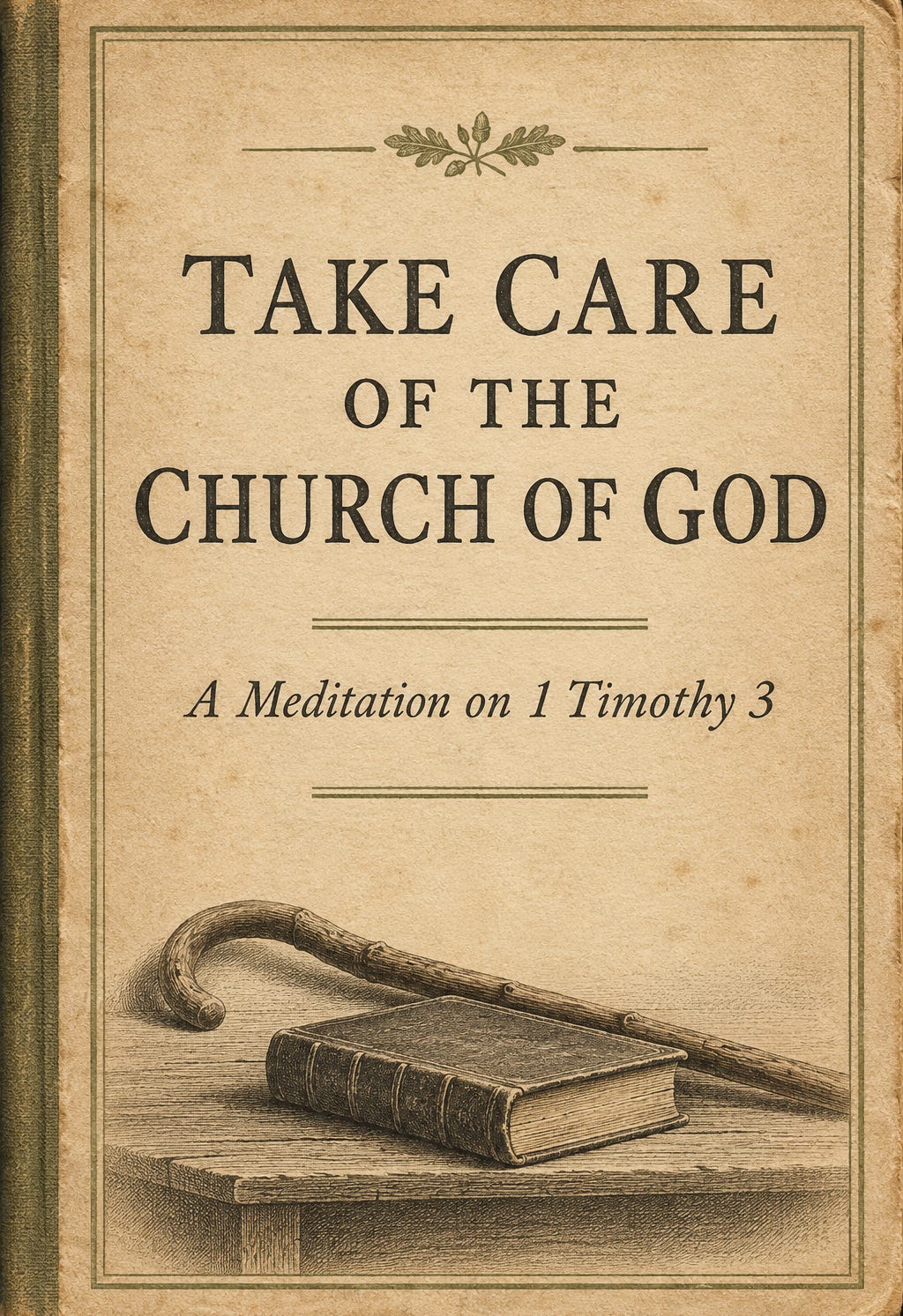
A man can’t divide himself in two, and be one man in the consistory room and another in the kitchen. The loving authority expected among the flock must be evident at the dinner table. The tenderness expressed to a hurting congregant must be known by a wife and children. Firm love, uniformity, and self-government must be consistent traits (though imperfect!). Paul asks, “For if a man know not how to rule his own house, how shall he take care of the church of God?” (3:5) Notice: “take care,” because in those two words we have our whole mandate.
Caring is consistory’s work in one word. The congregation is Christ’s flock, and we are stewards of her care. Under our oversight are souls purchased by His blood. Yes, even the difficult ones. Even the wandering prodigals. Even the sheep on the other side of the pasture who frustrate you, misunderstand you, or consume copious amounts of your energy; these are all entrusted. Impatience and harshness are disqualifying qualities.
Then Paul warns against pride. Pride is particularly dangerous for us. “Not a novice, lest being lifted up with pride he fall into the condemnation of the devil.” ( 3:6) People want to know our opinion. They listen to our words as we sit and listen to their confidential matters. We are entrusted with Christ’s keys of authority (Matt. 18:18). These can be misconstrued as power instead of service.
That’s why Paul says, “lest being lifted up with pride.” (3:6) Censure morum gives us opportunity to honestly ask if pride has entered our office of Christ. Can I receive correction constructively? Can I disagree without being adversarial? Can I admit that another man saw the issue more clearly than I did? Can I give up ground without feeling weak? Can I apologize? Brothers, these are all spiritual temperament questions, or spiritual intelligence quotient (SQ).
Paul then turns to the office of deacon. “Likewise must the deacons be grave...holding the mystery of the faith in a pure conscience.” (3:8, 9) There is that word again...conscience, “a pure conscience.” (1 Timothy 3:9) Brothers, that is what we should desire as we sit around this table. A collective conscience that is at peace with God and with each other.
If there is something between us that relates to our office, this is the time and place to speak. If a brother has offended, let us speak honestly and with charity. If we have offended, let us be swift to hear and slow to speak (Jas. 1:19). If there is sloth, if there is weakness, if there is undealt with sin, let’s seek forgiveness and restoration.
Censure morum is one of those “decently and in order” things our forefathers gifted us (1 Cor. 14:40). They understood that keeping a short account with each other prevents grievances from festering and disrupting the flock. It calls us all back to philadelphos, brotherly love.
This responsibility should make us feel helpless and bring us afresh to Christ. Who among us can say, “I have perfectly acquitted myself”? We know we haven’t. We see the sins of our character. We remember times when we have fallen short of our callings. We know the pride of our hearts. Thankfully, the church does not stand upon the perfection of its officers or pastor. She rests on the right arm of the Chief Shepherd. Only He is the perfectly blameless Overseer, the Great Shepherd, and Bishop of our souls (1 Pet. 2:25). He has never forsaken one. He governs His flock with both rod and staff, and bears patiently with her infirmities, because He loves His bride with an everlasting love. We serve beneath that authority.
So, as we come to censure morum tonight and go around this table, let’s come as open books. Let us plead that the Spirit would search us. Let’s give each other liberty to speak. Listen for any admonition, repent, and forgive freely. Would it be that the men who leave this room tonight, and the men to be elected soon, be more fitted to “take care of the church of God” (3:5) than ever before.
My dear brothers of Consistory, may the Holy Spirit continue to prove us, correct us, humble us, and conform us more and more to the image of Jesus, so that we may serve Him gladly with a pure conscience, and truly care for the flock which He has entrusted to us.
Your fellow servant in Christ,
J. Lewis