


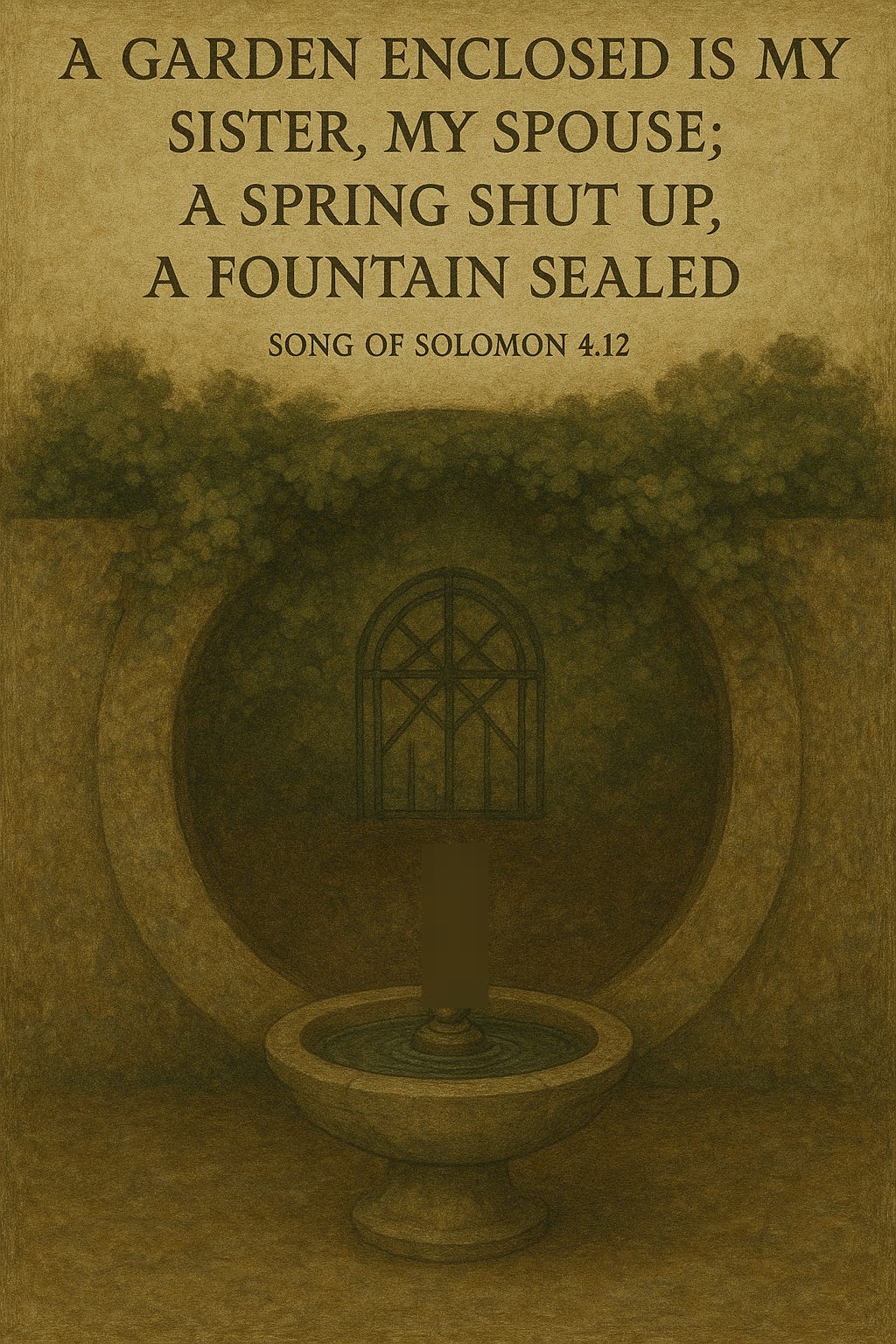
In the ancient Near East, a walled garden was a symbol of wealth and love, an oasis amid wilderness, accessible only to its keeper. Water was precious, life was guarded. To say “a garden enclosed” was to speak of delight that is protected, not diminished. It was the image of fruitful intimacy, rather than reclusion.
Western identity is more shaped by public life and self-expression, pictures of your meal, your devotional environment, favorite texts, and tends to question anything hidden.
But in Scripture, the hidden is holy. The ark was veiled (Exodus 40:21). The manna was kept in a golden pot (Hebrews 9:4). The Most Holy Place was curtained off (Exodus 26:33). Christ Himself often withdrew to solitary places (Luke 5:16), not because He lacked communion, but because He possessed it.
“A garden enclosed is my sister” (Song of Solomon 4:12).
When the Song calls the Bride “a garden enclosed,” it is highlighting this paradox: the soul is most open to God when it is most shut out to the world. Holy intimacy is secrecy turned heavenward, where the walls are not prison but covenant.
Every regenerate soul becomes a garden of God. He is the Master who tends it. What He plants, He guards. What He waters, He hides. The fence around this garden is not so much to keep joy in, but to keep corruption out. Where every act of grace creates an enclosure.
God does not save men into public squares of constant exposure, but into inward gardens, where He and the soul may speak together without witness.
On the other hand, the unregenerate heart is like an open field. Everything grows there. Weeds, thorns, and a few wildflowers of human goodness and virtue. It has no gate, no Master, no seal. But the heart made new by Christ becomes enclosed by His Spirit. The hedge of His providence rises, the wall of His Word encircles, and inside, quietly, the air begins to change. What was once barren begins to bear the scent of Eden.
“A garden enclosed is my sister, my spouse; a spring shut up” (Song of Solomon 4:12).
Inside this garden lies a spring shut up. Grace is not a picture. It has motion. The Spirit within the believer is a flowing life, never still, yet shut up. Not in the sense of suppression, but more like a sacred reserve. It is “shut up.” The stream is guarded from contamination. The world cannot drink from it; even self cannot fully sound its depth. It rises from beneath, from the hidden places where the Spirit Himself has entered the soul. Outward trials only make it clearer, inward trials only mineralize its worth, and pressure breaks the ground and reveals what runs beneath.
Then the image deepens: a fountain sealed. “A garden enclosed is my sister, my spouse; a spring shut up, a fountain sealed.”
In Scripture, the seal means three things: ownership, authenticity, and protection. Jacob rolled the seal off Laban’s well for Rachel in Genesis 29. It bore Laban’s signet. It belonged to him. The soul sealed by God bears Christ’s signet. She belongs to her Bridegroom. Her fountain is no longer for others. Her inward life is authenticated by His Spirit witnessing with hers that she is His (Romans 8:16).
And the seal protects: the enemy cannot unstop what Christ has closed, nor corrupt what grace keeps pure.
This is why sanctification feels both open and closed. There is a holy loneliness to the Christian life. The believer walks among men but lives with God. He converses, works, laughs, lives, yet something of him is elsewhere, hidden. The sealed fountain runs beneath all visible acts. No eye sees it but the Bridegroom’s. The soul has learned that love cannot be divided.
Here lies the supernatural wonder: union with Christ does not dissolve individuality; rather it completes it. The enclosed garden is a new creation, Eden in miniature. Every virtue, every holy affection, every tear shed for sin is one more blossom in that inner Eden. Its seasons may change, yet the fountain never runs dry.
And when the Beloved comes, “Let my beloved come into his garden, and eat his pleasant fruits” (Song of Solomon 4:16), He come as Possessor. The garden was His all along. What the soul calls “mine” was always “Thine.” He walks within, as once in the cool of the day (Genesis 3:8), and finds what His own Spirit has grown: love, joy, peace, longsuffering, fruit not native to this soil.
To dwell here is to discover that holiness is intimacy; not public virtue, but private delight. The spring shut up becomes, in the end, a river of life flowing out toward eternity, but it must first run deep in secret before it can run broad in glory.
"There is a place of quiet rest, near to the heart of God......"